Table of contents for the Rapporto di gestione 2025 report

Introduzione
Cifre principaliPunti salientiCosa è significato «Innovators of Trust» nel 2025?
Un’IA di 
cui fidarsiLa colonna portante del futuro digitaleUn nuovo ­operatore leader in ItaliaInsieme verso 
lo zero netto
Lettera agli azionisti
Mercato dei capitali
Azione SwisscomPolitica dei dividendiStrategia di finanziamento
Commento del management
Modello di businessPanoramica sul Gruppo
Acquisizione di Vodafone ItaliaOrganizzazione e strutturaBrand di SwisscomSegmenti operativi
Contesto e strategia commerciale
Contesto economicoContesto giuridicoMercato delle telecomunicazioni e delle tecnologie dell’informazioneObiettivi e strategia del Gruppo
Infrastruttura
Infrastruttura in SvizzeraInfrastrutture in Italia
Sistema di gestione finanziaria
Key Performance Indicator per i risultati finanziariKey Performance Indicator per la posizione finanziariaObiettivi finanziari e raggiungimento degli obiettivi nel 2025
Personale
Nuovo modello operativo per le risorse umanePersonale in SvizzeraPersonale in Italia
Prodotti e servizi
Segmento SvizzeraSegmento ItaliaSegmento altri
Innovazione e sviluppo
Condurre gli affari promuovendo sicurezza, fiducia, intelligenza artificiale e innovazionePrincipali ambiti di innovazione
Gestione dei rischi
Valutazione della situazione generale di rischioSistema di gestione del rischio d’impresaProcesso di gestione del rischioProgressi e prospettiveRischi principali
Andamento degli affari
Misure di performance alternativeKPI GruppoKPI segmentiRiepilogoAmmortamenti, risultati non operativiOnere fiscale sull’utileFlussi di cassaInvestimentiPosizione patrimoniale nettaDichiarazione di valore aggiunto
Prospettive finanziarie
Corporate governance
1 Principi generali2 Struttura del Gruppo e azionisti
2.1 Struttura del Gruppo2.2 Principali azionisti2.3 Partecipazioni incrociate
3 Struttura del capitale
3.1 Capitale3.2 Azioni, buoni di partecipazione e buoni di godimento3.3 Limitazioni alla trasferibilità e alle registrazioni di interposte persone3.4 Obbligazioni convertibili, prestiti obbligazionari e opzioni
4 Consiglio d’amministrazione
4.1 Membri del Consiglio d’amministrazione4.2 Formazione, attività professionali e affiliazioni4.3 Composizione del Consiglio d’amministrazione4.4 Indipendenza4.5 Elezione e durata del mandato4.6 Pianificazione della successione4.7 Sviluppo costante e formazione continua4.8 Presidente del Consiglio d’amministrazione4.9 Organizzazione interna e metodi di lavoro4.10 Comitati del Consiglio d’amministrazione4.11 Assegnazione delle funzioni4.12 Strumenti di reporting e controlling del ­Consiglio d’amministrazione in relazione alla Direzione aziendale del Gruppo
5 Direzione aziendale del Gruppo
5.1 Membri della Direzione aziendale del Gruppo5.2 Affiliazioni5.3 Accordi di gestione
6 Retribuzione, partecipazioni e prestiti7 Diritti di partecipazione degli azionisti
7.1 Limitazioni dei diritti di voto e deleghe7.2 Requisiti legali per il quorum7.3 Convocazione dell’Assemblea generale ordinaria e punti all’ordine del giorno7.4 Rappresentanza all’Assemblea generale ordinaria7.5 Iscrizione nel registro delle azioni
8 Modifica del controllo e misure difensive9 Ufficio di revisione
9.1 Processo di selezione, durata e condizioni del mandato del revisore incaricato9.2 Spese di revisione e costi aggiuntivi9.3 Vigilanza dei revisori
10 Politica dell’informazione11 Calendario finanziario12 Periodi di sospensione delle negoziazioni
Resoconto delle retribuzioni
Lettera del presidente della commissione Retribuzione1 Governance
1.1 Principi generali1.2 Ripartizione delle responsabilità tra Assemblea generale ordinaria, Consiglio d’amministrazione e commissione Retribuzione1.3 Nomina, composizione e modalità di lavoro 
della commissione Retribuzione
2 Retribuzione del Consiglio d’amministrazione
2.1 Principi generali2.2 Elementi di retribuzione2.3 Retribuzione totale (revisionato)2.4 Requisito di partecipazione azionaria minima2.5 Partecipazioni dei membri del Consiglio ­d’amministrazione (revisionato)
3 Retribuzione della Direzione aziendale del Gruppo
3.1 Principi generali3.2 Elementi di retribuzione3.3 Retribuzione totale3.4 Requisito di partecipazione azionaria minima3.5 Partecipazioni dei membri della Direzione aziendale del Gruppo (revisionato)3.6 Contratti d’impiego3.7 Clawback e malus
4 Altre retribuzioni (revisionato)
4.1 Retribuzione supplementare4.2 Retribuzione degli ex membri del Consiglio ­d’amministrazione o della Direzione aziendale del Gruppo e di loro parti correlate4.3 Prestiti e crediti concessi
5 Attività presso altre società 
(revisionato)
5.1 Consiglio d’amministrazione5.2 Direzione del Gruppo
6 Rappresentanza di genere (revisionato)Relazione del revisore dei conti
Sustainability Statements
The big picture
ESG ratings and awardsSwisscom Group’s contribution to the SDGs
Double materiality assessment
Business model and value chain
StakeholdersCorporate responsibility governanceEnvironment
Climate change (E1)
Transition plan for net zero 2035PoliciesReducing Scope 1 emissionsReducing Scope 2 emissionsReducing Scope 3 emissionsTargetsEnergy consumption and mixGHG emissionsBeyond value chain mitigation (BVCM)Avoided emissionsClimate resilience analysis
Resource use and circular economy (E5)
PoliciesActions on circular economyTargetsOutflows of resources and waste
Social
Own workforce (S1)
Working conditions and work-life balanceHealth and safetyDiversity, equity and inclusionTraining and skills development
Workers in the value chain (S2)Consumers and end users (S4)
Data protection, security and ethicsMedia literacy and protection of childrenNetwork access and expansion
Governance
Business conduct (G1)
Corporate cultureAnti-corruptionSupplier management
Annex and methodological note
Basis for preparationPolicy overviewReporting standards and frameworks
Independent Assurance Report
Financial Statements
Consolidated financial statements Swisscom Group
Consolidated statement of comprehensive incomeConsolidated balance sheetConsolidated statement of cash flowsConsolidated statement of changes in equityNotes to the consolidated financial statements
General information and changes in accounting policies1 Operating performance2 Capital and financial risk management3 Operating assets and liabilities4 Employees5 Scope of consolidation6 Other disclosures
Report of the statutory auditor
Financial statements of Swisscom Ltd
Income statementBalance sheetGeneral disclosuresFurther disclosuresProposed appropriation of retained earnings
Five-year review

Stakeholders

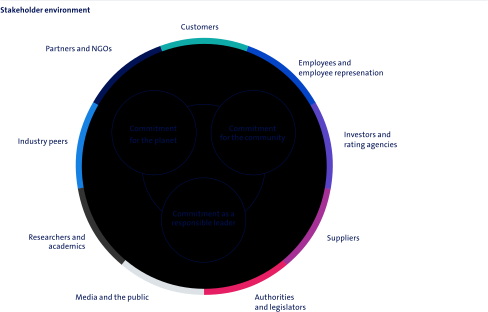
The Swisscom Group maintains ongoing dialogue with external stakeholders in Switzerland and Italy to keep up to date with their perspectives, concerns and expectations with respect to sustainability issues. This dialogue uses different formats and channels throughout the year, typically maintained by specialist departments. Insights inform day-to-day work streams, the double materiality assessment and the Group Sustainability Strategy, which are discussed and validated by management.
Grafik Share Performance

Customers

Purpose of engagement

Swisscom engages with customers to identify expectations that influence its business, including their perception of its sustainability practices. Fastweb + Vodafone focuses on strengthening digital channels, ensuring high quality standards, enhancing the clarity and transparency of services, and empowering consumers to better understand their rights.

Form of engagement (examples)

Recurring customer surveys, customer associations, reputation tracking, various communication channels e.g. website, hotline, newsletter, social media, MySwisscom and MyFastweb apps

Topics with greatest materiality
  • Climate change (E1)
  • Circular economy (E5)
  • Data protection, security and ethics (S4)
  • Media literacy and protection of children (S4)
  • Network access and expansion (S4)

Employees and their representatives

Purpose of engagement

Swisscom Group interacts with its employees through a variety of formats to understand interests and concerns and to improve the quality of working life, foster active engagement and promote the corporate culture.

Form of engagement (examples)

CEO coffee talk, management roadshows, intranet, surveys, employee associations and representatives, community events

Most material topics
  • Own workforce (S1)

Investors, analysts, rating agencies, proxy advisors

Purpose of engagement

Swisscom engages with capital market players to understand expectations around sustainability performance and strategy and how they influence investment decisions and ratings. Fastweb + Vodafone focuses on transparency in corporate governance and strategic management in dialogue with the financial community.

Form of engagement (examples)

Annual general meetings, investor conferences, bilateral exchanges, roadshows, official communications, systematic ESG rating feedback

Most material topics
  • Climate change (E1)
  • Circular economy (E5)
  • Own workforce (S1)
  • Data protection, security and ethics (S4)
  • Corporate responsibility governance (ESRS 2)

Suppliers

Purpose of engagement

The procurement functions of Swisscom and Fastweb + Vodafone are responsible for supplier management, which includes collaboration on sustainability issues and ethical values. The Swisscom Group conducts annual supplier audits as part of the Joint Alliance for CSR (JAC).

Form of engagement (examples)

Supplier qualification process and management platforms, carbon reduction programme, JAC conferences and supplier audits, Save the Children remediation project

Topics with greatest materiality
  • Climate change (E1)
  • Circular economy (E5)
  • Workers in the value chain (S2)

Authorities and legislators

Purpose of engagement

Swisscom plays a constructive part in legislative and regulatory processes through intensive dialogue with authorities, political parties and public associations. Fastweb + Vodafone uses its technical expertise to actively contribute to the development of regulatory proposals.

Format of engagement (examples)

Specialist industry workshops and working groups, public consultation procedures, projects and exchanges; VEK, Swisscleantech, Swico, BFE, BAFU, Federal Office for Cyber Security, Computer Security Incident Response Team, Swiss Security Association, European Telecommunications Industry Association (ETIS), Forum of Incident Response and Security Teams (FIRST) and Global Security Management Association (GSMA)

Topics with greatest materiality
  • Data protection, security and ethics (S4)
  • Network access and expansion (S4)
  • Climate change (E1)
  • Circular economy (E5)

Media and the public

Purpose of engagement

Swisscom and Fastweb + Vodafone monitor and engage with the media and the public to understand the discourse on material issues and how it may shape reputational and regulatory risks. They ensure transparent communication regarding strategies, initiatives and results.

Format of engagement (examples)

News subscriptions, press releases, press conferences, website, events e.g. Sustainable Switzerland

Topics with greatest materiality
  • All topical standards

Research and academics

Purpose of engagement

Swisscom and Fastweb + Vodafone collaborate with researchers and academic institutions to gather science-based insights on long-term environmental and social impacts and to facilitate knowledge-sharing.

Format of engagement (examples)

Topical discussions, joint projects (studies) and events with institutions such as Bern University of Applied Sciences, ETH Zurich, École polytechnique fédérale de Lausanne (EPFL), University of Zurich, University of Palermo, Luiss Guido Carli University

Topics with greatest materiality
  • Climate change (E1)

Industry peers

Purpose of engagement

Swisscom and Fastweb + Vodafone are in dialogue with industry peers for benchmarking and capturing of systemic risks and opportunities relevant to the sector.

Format of engagement (examples)

Regular working groups with JAC and asut, bilateral exchanges, ASSTEL, Clusit, BIF, ECTA, ITU, Confindustria, Assolombarda

Topics with greatest materiality
  • Climate change (E1)
  • Circular economy (E5)
  • Workers in the value chain (S2)
  • Customers and end users (S4)

Partners and NGOs

Purpose of engagement

Swisscom collaborates with NGOs and civil society partners to assess its societal and environmental impacts and gather insights on emerging issues. Fastweb + Vodafone aims to support civil society through numerous initiatives in the environmental, social and economic fields.

Format of engagement (examples)

Recurring exchanges, collaboration and membership or organisations such as myclimate, WWF, CEO4Climate, Kinderschutz Schweiz, Association of Swiss Teachers, Swiss Association of the Deaf, SOS Children’s Villages Switzerland, Save the Children, Allianz digitale Inklusion Schweiz, Verband für nachhaltiges Wirtschaften (OEBU), Syndicom, Transfair, Réalise

Topics with greatest materiality
  • Climate change (E1)
  • Circular economy (E5)
  • Data protection, security and ethics (S4)
  • Media literacy and protection of children (S4)