Stakeholders
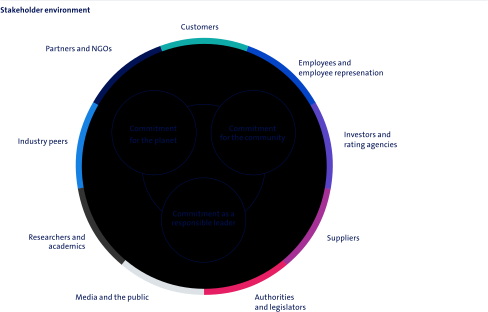
The Swisscom Group maintains ongoing dialogue with external stakeholders in Switzerland and Italy to keep up to date with their perspectives, concerns and expectations with respect to sustainability issues. This dialogue uses different formats and channels throughout the year, typically maintained by specialist departments. Insights inform day-to-day work streams, the double materiality assessment and the Group Sustainability Strategy, which are discussed and validated by management.
Customers
Purpose of engagement
Swisscom engages with customers to identify expectations that influence its business, including their perception of its sustainability practices. Fastweb + Vodafone focuses on strengthening digital channels, ensuring high quality standards, enhancing the clarity and transparency of services, and empowering consumers to better understand their rights.
Form of engagement (examples)
Recurring customer surveys, customer associations, reputation tracking, various communication channels e.g. website, hotline, newsletter, social media, MySwisscom and MyFastweb apps
Topics with greatest materiality
- Climate change (E1)
- Circular economy (E5)
- Data protection, security and ethics (S4)
- Media literacy and protection of children (S4)
- Network access and expansion (S4)
Employees and their representatives
Purpose of engagement
Swisscom Group interacts with its employees through a variety of formats to understand interests and concerns and to improve the quality of working life, foster active engagement and promote the corporate culture.
Form of engagement (examples)
CEO coffee talk, management roadshows, intranet, surveys, employee associations and representatives, community events
Most material topics
- Own workforce (S1)
Investors, analysts, rating agencies, proxy advisors
Purpose of engagement
Swisscom engages with capital market players to understand expectations around sustainability performance and strategy and how they influence investment decisions and ratings. Fastweb + Vodafone focuses on transparency in corporate governance and strategic management in dialogue with the financial community.
Form of engagement (examples)
Annual general meetings, investor conferences, bilateral exchanges, roadshows, official communications, systematic ESG rating feedback
Most material topics
- Climate change (E1)
- Circular economy (E5)
- Own workforce (S1)
- Data protection, security and ethics (S4)
- Corporate responsibility governance (ESRS 2)
Suppliers
Purpose of engagement
The procurement functions of Swisscom and Fastweb + Vodafone are responsible for supplier management, which includes collaboration on sustainability issues and ethical values. The Swisscom Group conducts annual supplier audits as part of the Joint Alliance for CSR (JAC).
Form of engagement (examples)
Supplier qualification process and management platforms, carbon reduction programme, JAC conferences and supplier audits, Save the Children remediation project
Topics with greatest materiality
- Climate change (E1)
- Circular economy (E5)
- Workers in the value chain (S2)
Authorities and legislators
Purpose of engagement
Swisscom plays a constructive part in legislative and regulatory processes through intensive dialogue with authorities, political parties and public associations. Fastweb + Vodafone uses its technical expertise to actively contribute to the development of regulatory proposals.
Format of engagement (examples)
Specialist industry workshops and working groups, public consultation procedures, projects and exchanges; VEK, Swisscleantech, Swico, BFE, BAFU, Federal Office for Cyber Security, Computer Security Incident Response Team, Swiss Security Association, European Telecommunications Industry Association (ETIS), Forum of Incident Response and Security Teams (FIRST) and Global Security Management Association (GSMA)
Topics with greatest materiality
- Data protection, security and ethics (S4)
- Network access and expansion (S4)
- Climate change (E1)
- Circular economy (E5)
Media and the public
Purpose of engagement
Swisscom and Fastweb + Vodafone monitor and engage with the media and the public to understand the discourse on material issues and how it may shape reputational and regulatory risks. They ensure transparent communication regarding strategies, initiatives and results.
Format of engagement (examples)
News subscriptions, press releases, press conferences, website, events e.g. Sustainable Switzerland
Topics with greatest materiality
- All topical standards
Research and academics
Purpose of engagement
Swisscom and Fastweb + Vodafone collaborate with researchers and academic institutions to gather science-based insights on long-term environmental and social impacts and to facilitate knowledge-sharing.
Format of engagement (examples)
Topical discussions, joint projects (studies) and events with institutions such as Bern University of Applied Sciences, ETH Zurich, École polytechnique fédérale de Lausanne (EPFL), University of Zurich, University of Palermo, Luiss Guido Carli University
Topics with greatest materiality
- Climate change (E1)
Industry peers
Purpose of engagement
Swisscom and Fastweb + Vodafone are in dialogue with industry peers for benchmarking and capturing of systemic risks and opportunities relevant to the sector.
Format of engagement (examples)
Regular working groups with JAC and asut, bilateral exchanges, ASSTEL, Clusit, BIF, ECTA, ITU, Confindustria, Assolombarda
Topics with greatest materiality
- Climate change (E1)
- Circular economy (E5)
- Workers in the value chain (S2)
- Customers and end users (S4)
Partners and NGOs
Purpose of engagement
Swisscom collaborates with NGOs and civil society partners to assess its societal and environmental impacts and gather insights on emerging issues. Fastweb + Vodafone aims to support civil society through numerous initiatives in the environmental, social and economic fields.
Format of engagement (examples)
Recurring exchanges, collaboration and membership or organisations such as myclimate, WWF, CEO4Climate, Kinderschutz Schweiz, Association of Swiss Teachers, Swiss Association of the Deaf, SOS Children’s Villages Switzerland, Save the Children, Allianz digitale Inklusion Schweiz, Verband für nachhaltiges Wirtschaften (OEBU), Syndicom, Transfair, Réalise
Topics with greatest materiality
- Climate change (E1)
- Circular economy (E5)
- Data protection, security and ethics (S4)
- Media literacy and protection of children (S4)